Contents
The quote that stopped the scroll
Official Report
Currently, a total of Five Hundred and Twenty (520) referrals has been made to Twenty-Seven (27) Committees for consideration and report.
Mahama Ayariga, Bawku Central
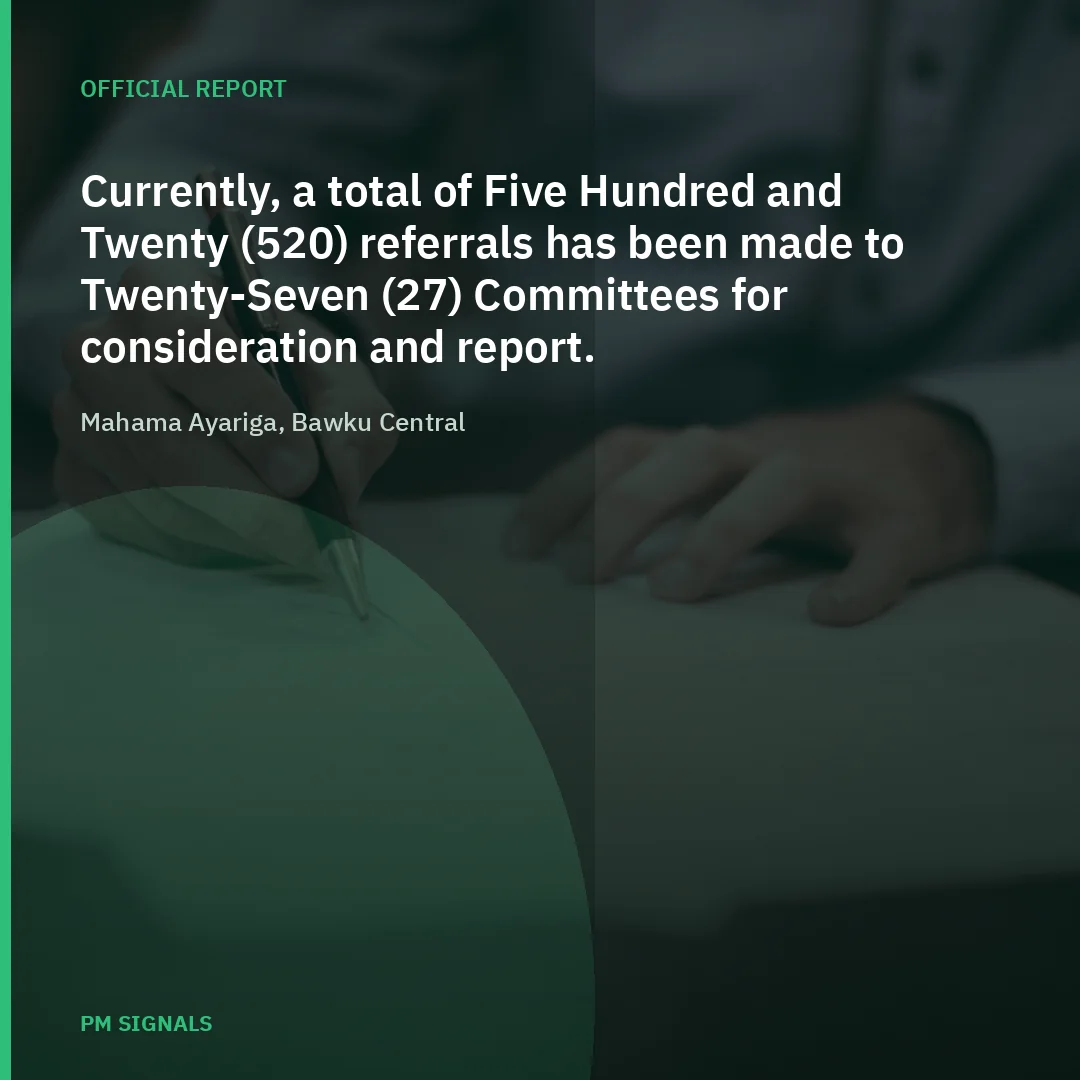
Majority Leader Mahama Ayariga (Bawku Central) told the House that 520 referrals are sitting with 27 committees. The figure measures delay in public business. It is not only committee paperwork.
During the Business of the House, the Majority Leader put a number on the referral backlog and pressed members to address it during the recess. The chamber moment is procedural, but the scale is what political feeds will repeat.
What the record reveals
The Business Committee reported a backlog of 520 referrals distributed across 27 committees. The Official Report does not, by itself, establish how old each referral is, what resources each committee has, or which referrals are most consequential.
System analysis
A large referral backlog can slow scrutiny, reporting, legislative follow-through, and public accountability. It may reflect coordination costs, limited research capacity, uneven committee workload, weak tracking, or the complexity of the matters being considered.
Market gap
The evidence supports investigating tools and services for parliamentary workflow visibility: referral tracking, document management, research support, committee scheduling, reporting dashboards, and structured access to public legislative data. The commercial opportunity is not proven; demand, procurement ownership, data access, and willingness to pay remain open questions.
Execution blueprint
Map the referral lifecycle from assignment to committee report; identify where status information is lost; speak with committee staff, researchers, civil-society monitors, and parliamentary technology stakeholders; prototype a lightweight tracking and reporting workflow; then test whether the problem is specific to Parliament or part of a wider public-sector case-management market.
What to investigate next
Watch for the age and category of the 520 referrals, committee-level workload differences, progress reported after the recess, existing digital workflow systems, and any budget or procurement signals connected to parliamentary modernisation.
💬 Leave a Reply
Your email address will not be published. Required fields are marked *